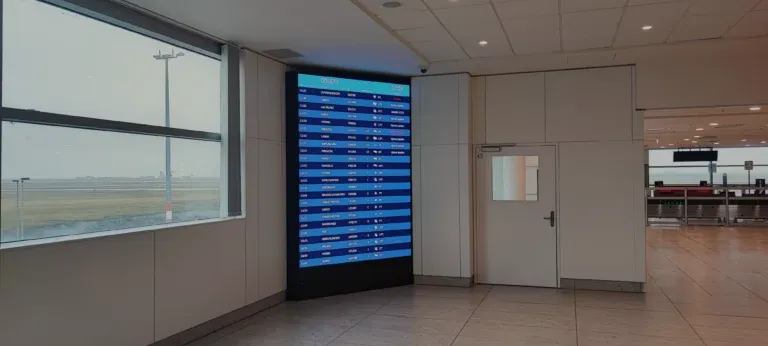
Forecast of the digital advertising market development for the next 6 years
In the modern world, digital advertising has become not only an integral part of our daily lives but also an essential tool for businesses and marketing.

LED screens have gained particular popularity due to their brightness, wide color spectrum, and high resolution, capable of capturing the audience’s attention and making advertising more effective. However, LED screen technologies are constantly evolving, and content management software is becoming increasingly extensive and functional.
Undoubtedly, content management system is the key important element for various visual formats, from video walls in retail to large LED screens used in Digital Out-of-Home (DOOH) advertising. DOOH Advertising is becoming increasingly popular due to its effectiveness and the ability to precisely target the audience. Media facades for Shopping Mall Entertainment Centers (SMEC) and screens for advertising on outdoor advertising structures are transforming into true interactive platforms, offering not only advertising but also informational and entertainment content.
However, to fully harness the potential of LED screens, appropriate software is necessary. Modern developers are actively working on expanding the capabilities of software for DOOH Display Solutions. This includes the development of programs for content management, advertising effectiveness monitoring and analysis, as well as integration with centralized video management systems.
Some CMS providers position one of their main advantages – the ability to provide free screen software for testing, allowing even small businesses and advertising operators to try out these technologies without costs.
The growing popularity of DOOH networks indicates that this advertising market segment will continue to develop actively. And with each new advancement in LED screen technologies and software for them, we see new opportunities for businesses and more effective communication with the audience.
A LED screen is a complex electronic device that contains a large number of components. The image quality and operational characteristics of the LED screen depend on both the parameters of the components used in the screen and the capabilities of the system managing this screen.
From the perspective of image quality, the following characteristics of the screen are important:
– Screen resolution (known as spatial resolution), in the case of LED screens, usually expressed in the distance between pixels (pitch size);
– Maximum brightness (measured in Nits);
– Dynamic range of brightness, expressed in the number of brightness levels that can be displayed on the LED screen (this characteristic is also called radiometric or energy resolution);
– Frame change frequency, expressed in the number of frames shown per second (fps) (this is the temporal resolution);
– Frame refresh rate (refresh rate), measured in Hertz (this is also a temporal resolution);
– Spectral resolution – how many spectral components form the image;
– Color uniformity across the entire screen;
– White balance and its adjustability;
– Linearity of brightness perception – a subjective characteristic of image quality, expressed in the ability to distinguish close brightness levels both in dark areas of the image and in bright ones;
– Screen image contrast;
– Characteristics of the screen image quality change depending on the viewing angle.
In addition to image quality, it is also worth noting the following operational characteristics of the LED screen:
– The presence of a monitoring system for the LED screen’s condition;
– The sophistication of the CMS (Content Management System) software (ability to build networks of LED screens, including networks containing both LED and LCD screens, ability to control screens over the Internet, presence of a built-in information security subsystem);
– The level of electromagnetic radiation in the form of industrial radio interference generated by the LED screen.
Today, the LED screen market and its software continue to actively develop, providing more opportunities for businesses and advertising projects. The use of modern management and control technologies for LED screens becomes the key to success in this competitive market segment.
Key characteristics and optimal size
LED screens have become an essential tool for digital advertising, especially for Digital Out-of-Home (DOOH) advertising, offering extensive audience engagement opportunities. The development of these technologies includes not only hardware solutions but also software for effective management of video walls and LED screen networks.
One of the key characteristics of LED screens is their resolution, measured in the number of pixels per square meter. The optimal resolution depends on the screen size and the viewing distance anticipated. It is also important to consider the pixel pitch – the distance between the central point of one pixel and the central point of the adjacent one. The smaller the pitch, the higher the screen resolution and image quality.
To achieve the optimal selection of size and pixel pitch, it is important to consider the requirements of the specific advertising project and its location conditions. For example, for media facades in Shopping Mall Entertainment Centers (SMEC), it is important to choose parameters that provide clear and attractive content display at significant distances.
With the development of software for managing LED screens, we are witnessing an increase in their usability in various industries, including digital advertising and informational media facades. This allows businesses to create effective and impressive advertising campaigns, as well as provides convenient management of LED screen networks using centralized video management systems.
Considering all these aspects allows for the optimal use of LED screens in advertising projects, ensuring maximum impact and effectiveness of communication with the audience.
Technologies DIP and SMD in LED screens and characteristics and applications
LED screens offer a wide range of configurations that affect their characteristics and applications. The DIP (Dual In-line Package) and SMD (Surface Mount Device) configurations are determined by the placement and grouping of LEDs in the housing, affecting brightness, resolution, and image quality.
DIP configuration modules are typically used for outdoor advertising screens and media facades for Shopping Mall Entertainment Centers (SMECs). They are characterized by high brightness, sturdy housing, resistance to negative temperatures and moisture. Such modules allow for clear and bright images, which are important for outdoor use. However, they may have a limited viewing angle.
On the other hand, the SMD configuration provides high-quality color reproduction and greater image detail. These modules are usually used indoors, such as concert halls, studios, and airports. They have lower brightness compared to DIP modules, but this is sufficient for indoor use, where comfortable viewing is important.
The development of software for managing LED screens allows for maximum utilization of their capabilities in advertising campaigns and media facades. The choice of screen configuration depends on the specific task and conditions of use, and the right choice will achieve optimal results.
More and more companies and advertising agencies perceive LED screens as an important tool for achieving their marketing goals. Due to the constant development of software technologies for managing video walls and the increasing options for screen configurations, we are witnessing a growth in the number of advertising projects using LED screens.
Regardless of whether you choose a DIP or SMD configuration for your project, it is important to understand your needs and audience requirements. Innovations in digital advertising and software for managing video walls continue to open up new possibilities for creativity and effectiveness in advertising campaigns.
World demand for LED displays and market growth rates
According to a new report by Zion Market Research, in 2023, the size of the global LED display market was estimated at $15.3 billion, and by 2030, it is projected to reach $23.3 billion, with an average annual growth rate of 7.5% from 2023 to 2030.
Key players mentioned in the report include Planar Systems Inc., Toshiba Corporation, NEC Corporation, Barco N.V., Panasonic Corporation, Leyard Europe, Samsung LED Co. Ltd., DeepSky Corporation Ltd., Daktronics, Inc., AOTO Electronics Co., Ltd., LG Electronics, Inc., Koninklijke Philips N.V., ViewSonic Corporation, Sony Corporation, Xi’an NovaStar Tech Co., Ltd., LianTronics Co., Ltd., and others.
Therefore, the development of the LED technology market opens the way to greater impact and effectiveness in advertising and media facades, creating bright, impressive, and memorable impressions for the audience.
Advision — Content Management System for remote management and media planning of broadcast video and audio content. We help offline businesses and advertising companies automate workflows and implement a robust Digital Signage infrastructure using our proprietary software and hardware solutions.
Contact us, and we will help you implement the most modern technologies to solve your problems!