5 inspiring use cases of Digital Signage in retail
For businesses, ignoring modern technologies in the 21st century is almost the same as moving backward without seeing the road.

The market is developing rapidly, and those companies win that not only follow changes, but shape them themselves. That is why today more and more brands invest in solutions that combine communication, design, and technology. In this article, we will look at how well-known global players use Digital Signage to create next-generation stores.
Modern retail is not only shelves with products. It is a space where the customer interacts with the brand on several levels at the same time. Modern digital advertising helps make this interaction flexible, dynamic, and максимально relevant to the situation here and now.
Why market leaders use digital signage
First of all, for information presentation. Advertising screens make it possible to show not only the price or product name, but also video, animation, usage scenarios, and comparisons. This significantly simplifies choice and increases trust in the brand.
The second important aspect is the WOW effect. Visually well-designed Digital Signage shapes the atmosphere of the store, enhances emotions, and holds the customer’s attention. People spend more time in the retail space, which directly affects the average check.
Another reason is the creation of a new customer experience. Interactive scenarios, adaptive content, and personalized messages form exactly the kind of experience that people want to share on social networks. This is where the advantages of digital advertising compared to static media are especially evident.
Traffic attraction is also no less important. Dynamic visual content draws attention even in an information-overloaded environment. It is hard to pass such solutions indifferently, especially in large shopping centers or on busy streets.
If you still imagine only simple screens with running text, it is worth expanding that perception. Today, digital signage is a full-fledged multimedia system that works as a tool for branding, sales, and analytics. A central role here is played by advertising content management, which allows messages to be quickly updated, hypotheses to be tested, and communication to be adapted to different audiences.
That is why Digital Signage is transforming from an additional design element into a strategic business asset that influences brand perception, customer behavior, and final sales.
Why modern Digital Signage technology helps business growth
Market size and growth rate:
– According to Market.us Scoop, the global digital display market is estimated at approximately $31.8 billion in 2025 and continues to grow steadily each year.
– According to analysts’ forecasts, the average annual growth rate (CAGR) for 2025–2030 is around 8% or more, which indicates a growing business demand for interactive digital solutions.
Impact on sales and marketing:
– Brands that have implemented digital displays, according to research data, can see an increase in incremental sales of up to ~33% compared to traditional advertising.
– Retailers and QSRs (quick service restaurants) report a 24–38% increase in sales of promotional items when they are promoted through digital screens instead of static print.
Customer interaction:
– Studies show that up to 80% of consumers prefer stores with digital communication, perceiving them as more modern and reliable.
– Menus and information panels based on Digital Signage can reduce the subjective perception of waiting time by 35%, which increases customer satisfaction levels.
Other benefits for business:
– Dynamic content allows messages to be updated in real time, quickly adapting information to changes in assortment, seasonality, or demand.
– Analysis of interactions with digital displays provides valuable business analytics that help optimize marketing strategies and improve ROI efficiency.
– Digital signage with interactive options and personalization increases consumer engagement and contributes to longer interaction with the brand.
1. Meitu: how makeup try-on turned into a digital adventure
Imagine entering a store and immediately finding yourself in the future of the beauty industry. This is exactly the effect created by Meitu in its digital showroom in the Chinese city of Xiamen. Here, technologies do not simply complement the retail space, but form a full-fledged brand interaction experience.
From the very first seconds, attention is drawn to a huge 3D screen at the entrance. Realistic images of animals and deep visual scenes instantly immerse visitors in an atmosphere of innovation. Such wide-format monitors work as a visual magnet and set an emotional tone even before getting acquainted with the products.
At the center of the space are interactive touch stations. Here, visitors can take selfies, try on digital makeup, retouch images, and immediately share the result on social networks. All these scenarios operate on the basis of Digital Signage software, which combines graphics, cameras, and interactivity into a single system.
A separate area is occupied by displays for makeup testing. Customers can “try on” different shades of lipsticks, eyeshadows, or blushes without physical testers. This is not only convenient, but also meets modern hygiene requirements, which is especially important for cosmetic retail.
The space is complemented by digital décor. Digital Signage transform walls into dynamic canvases that change depending on the theme of the collection or the marketing campaign. The content is synchronized through a centralized video management system, which ensures a unified style and control over all areas of the showroom.
Interactive panels for exploring reviews and product characteristics are also installed in the store. The customer independently chooses which information to view, while the brand gains the ability to quickly update materials thanks to remote content management without interfering with the store’s operations.
The Meitu example shows how digital technologies can turn an ordinary purchase into an engaging experience that combines emotions, personalization, and a modern approach to retail.
2. Amazon: making offline shopping comfortable and pleasant
Amazon’s cosmetics store in Milan is a true laboratory of the future, where technology does not distract from shopping, but instead makes it easier and more enjoyable. The space is designed so that people do not get lost, do not waste time searching for the right product, and receive prompts exactly when they are appropriate.
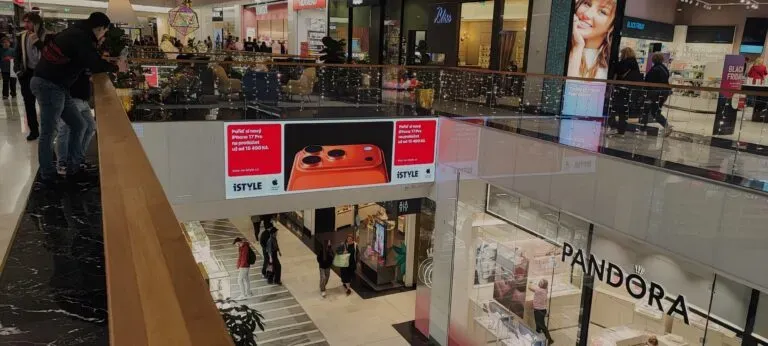
At the entrance and at key points along the route, LED pylons and video totems are installed. Instead of static signs, visitors are greeted by dynamic prompts that help them quickly find the right department and better understand the store’s layout. Such LED advertising screens work simultaneously as navigation and as a communication tool: they can display promotions, new arrivals, and product selections depending on the zone.
Next, the shopper is accompanied by ceiling-mounted video screens with friendly communication. They create a feeling of a “soft route,” when a person seems to move guided by prompts, but without pressure. It is important that this content is coordinated across different points and does not contradict itself — that is why the entire infrastructure works as a digital signage system, in which messages look cohesive and the brand style is immediately recognizable.
A separate element of the experience is the interactive assistant. It uses AI to analyze the visitor’s interests and suggest relevant cosmetic options — from basic recommendations to selections tailored to a specific request. For stores of this format, this is important because some customers want quick advice without consulting staff, but with a sense of personalization.
The most “magical” scenario looks like Place&Learn. The visitor picks up a product — and immediately sees information on the screen: reviews, videos with usage examples, ingredients, tips on shades, or alternatives. For such scenarios to work without delays and with consistent quality across different zones, the store uses an Indoor TV player that ensures stable playback and correct screen synchronization throughout the day.
3. Nike: surrounding sneakers with technological solutions
The Nike store in Paris uses advanced technologies not for spectacle, but to emphasize the brand’s idea of constant forward movement. Here, technology becomes part of the story: the space seems to speak to the visitor in the language of sport, rhythm, discipline, and achievement, and sneakers are transformed from a product into a symbol of culture.
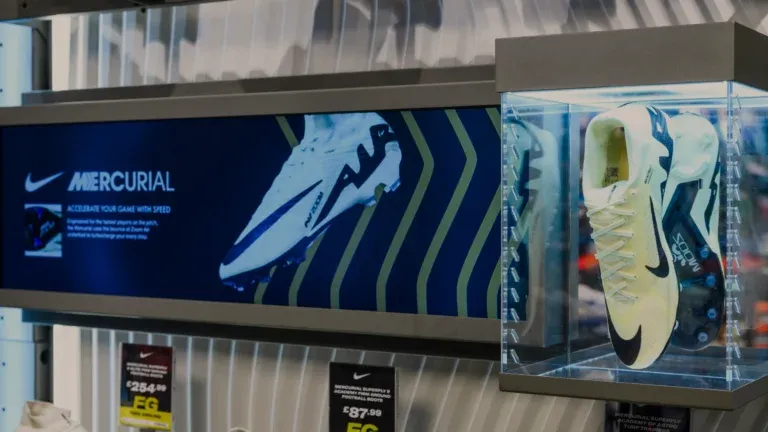
Video showcases, LED walls, and light columns create a multi-layered visual environment. The screens do not simply broadcast advertising videos — they show fragments of sports stories, the atmosphere of matches and training sessions, motivational messages, and elements of brand identity.
Such content needs to be updated quickly according to collections, events, or campaigns, which is why all management is carried out through Indoor TV software that allows flexible scheduling of displays and changing scenarios without physical presence in the store.
Holographic systems make a separate impression. For the presentation of Air Max Dn, transparent cylinders with HYPERVSN holographic technology were created, in which 3D models of sneakers “float.” This is the kind of format that people want to film on video and examine from different angles, because the product literally comes alive in the space.
To ensure that such a high level of visual quality remains stable, technical reliability is critically important. That is why maintenance of LED screens plays a major role in such installations: control of brightness, module condition, color calibration, and prevention of failures. As a result, the visitor sees not “technology,” but a perfectly assembled experience that enhances the emotional impact of the brand.
4. Adidas: created the store of the future
The adidas flagship boutique as of early 2022 was considered one of the largest digital stores in the world. Its concept was built not around individual screens, but around a holistic experience, where architecture, light, and content work as a single mechanism. The space is designed so that the customer does not simply choose a product, but immerses themselves in the brand’s philosophy.
The store’s windows are designed with large transparent LED screens. Dynamic content is broadcast on them, which at the same time attracts attention from outside and allows people to look inside the store. This approach blurs the boundary between the street and the retail space and makes the brand more open to the urban environment.
Lighting solutions play a key role in shaping the atmosphere. Illuminated ceilings and floors with running text create a sense of movement and tension, similar to the atmosphere of a major sports competition. The content in these zones changes synchronously, which enhances the emotional effect and immerses the visitor in a world of achievement and victory.
Special attention is deserved by the plinths for mannequins with a mirrored surface. Inside the structures, LED strips with text are placed, which is reflected in the mirror and repeated multiple times, creating a depth effect. Such an installation works both as an art object and as a carrier of a branded message.
The store also uses an LED screen with built-in shelves for footwear. This non-standard solution combines the physical product and digital content, drawing attention to specific models and allowing accents to be quickly changed depending on the collection or campaign. Consistency of displays across different zones is ensured by synchronization of advertising content, thanks to which the store looks like a single living space.
Interactive fitting rooms add personalization. After trying on, the visitor can choose a digital background — for example, a stadium or a runway — take a photo, and share it on social networks. All interaction scenarios are managed through a CMS application, which allows backgrounds, effects, and logic to be updated quickly without technical delays.
Separate zones, such as the Maker Lab, engage the customer in co-creation. Here, one can choose a print design and customize the purchased item. And the children’s zone “Clean the Ocean” presents the brand’s environmental initiatives in a playful form, engaging younger audiences in the topic of sustainable development.
Managing such a complex digital environment is impossible without clearly structured processes. It is precisely the administration of the broadcast system that allows stable operation of screens, interactive zones, and lighting installations throughout the entire day.
5. Apple Store: digital minimalism as part of the brand
Modern Apple Stores in the USA and Europe demonstrate a different approach to digital retail — restrained, yet technologically refined. There is no visual overload here, and digital solutions work as an extension of the philosophy of simplicity and convenience.
Large displays are used for product presentations, Today at Apple educational sessions, and events. Content is updated centrally and uniformly for stores in different countries, which makes it possible to maintain a single communication standard. This approach is implemented through cloud-based digital signage, which simplifies scaling and network control without complex local infrastructure.
Thanks to this, Apple can quickly launch global campaigns, adapt content to regional events, and maintain stable display quality. The Apple Store example shows that digital technologies do not necessarily have to be aggressive — they can be almost invisible, yet extremely effective.
In 2025, Digital Signage has ceased to be just a tool of visual communication and is becoming a full-fledged driver of business development. Statistics show that companies achieve real sales growth, better customer interaction, and flexibility in content management. That is why modern digital signage is increasingly viewed not as an expense, but as a strategic investment with a measurable effect.
Advision is a content management system for remote control, media planning of video and audio content broadcasting, and a supply-side platform for monetising advertising time. We also implement a Wi-Fi tracking system to measure quantitative indicators of the advertising audience.
We help Digital Signage owners and DOOH advertising operators earn money from advertising, automate work processes, and build a reliable media infrastructure using AdTech and MarTech software solutions.
Contact us if you want to increase your profits and implement the latest technologies to solve your problems!