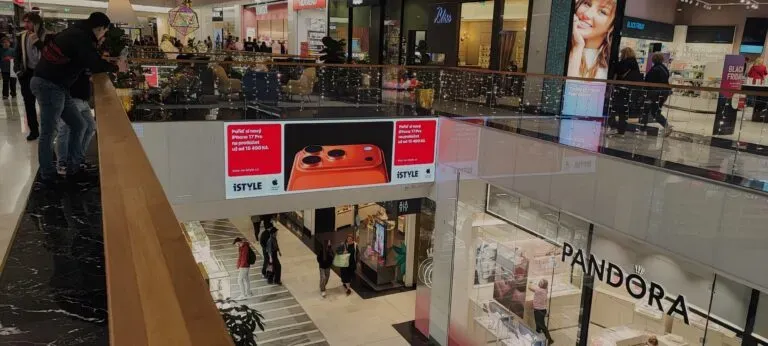
Digital screens in cafés: 3 steps to display relevant advertising
Have you ever wondered why digital screens in cafés often cause irritation, while printed posters are almost never noticed?

At first glance, it may seem that the problem lies in the technology itself. But in practice, the reason lies in the approach to content and the role of screens within the space of the venue.
Café owners invest in screens expecting to increase the average check and simplify communication with guests. Over-the-counter digital menu boards usually do not cause negativity, as they perform a clear function — they show the assortment and prices. In contrast, screens in the seating area are often perceived as an unnecessary element: they distract from conversation, interfere with focusing on food, and stand out from the overall mood of the space.
A logical question arises: why does no one complain about printed posters? The reason is simple — they are hardly noticed. Digital screens attract attention through motion and brightness, so any mistake in the content becomes immediately visible. If information boards and menus are not updated or do not match the context, they begin to work against the venue.
For screens not to cause irritation, they must be a tool for creating atmosphere in the business, not a random advertising medium. Content should take into account the time of day, seasonality, weather, and the guest’s visit scenario. A person who comes in during winter to warm up is unlikely to respond positively to advertising cold drinks with ice.
In practice, the main irritation is caused not by the format itself, but by mistakes in content management. Brands often treat screens just as formally as they previously treated printed materials:
– outdated banners remain on screens
– the lunch menu does not switch on time
– promotions that have already ended continue to be shown
– prices on screens do not match the cash register
In such situations, visitors subconsciously lose trust in the venue, even if they do not articulate it directly.
The solution is a systematic approach to content. Digital Signage software makes it possible to centrally manage screens, quickly update information, and avoid such mistakes. This is especially important for venues where information boards and menus change several times a day.
Interactive displays play a distinct role in HoReCa. They are perceived much more positively when they provide clear value for the guest:
– help choose a dish or drink faster
show ingredients, allergens, or recommendations
– reduce the workload on staff
– create a sense of modern, well-thought-out service
In such scenarios, screens stop being an irritant and become a logical part of the space. If needed, I can further expand any section or add practical examples.
The marketer’s task is to anticipate critical moments, prevent them in time, and constantly monitor the relevance of information for the guest. But how can this be done when a network includes dozens of venues in different cities, with different traffic levels, weather conditions, and audience behavior? Manual management at this scale quickly turns into chaos.
In theory, it is possible to involve the staff of each café, ask them to switch creatives via flash drives, or connect to each screen remotely. In practice, this means loss of time, errors, delays, and a constant human factor. That is why chain venues are increasingly moving to a digital signage system, where most processes are automated and do not require daily manual intervention.
Automation makes it possible not just to display advertising, but to manage it logically and systematically. Content changes depending on the season, time of day, day of the week, or external conditions, while the marketer controls everything from a single interface.
How to automate the display of relevant advertising
Step 1. Select seasonal items
Start by analyzing sales from previous years. See which dishes and drinks consistently sell better in winter and which in summer. Based on this data, create a list of seasonal items and develop separate creatives for them. This approach is useful even for venues that still use printed materials, but in a digital format it reveals its full potential.
Seasonal content works only when it is displayed on time. If winter offers remain on screens in March, they stop being taken seriously and cause irritation.
Step 2. Choose a content management system
At this stage, it is critically important to select a CMS application that is understandable for a marketer, not only for IT specialists. The interface should allow materials to be uploaded quickly, playlists to be created, and display schedules to be changed without complex technical settings.
It is worth clarifying in advance what equipment the platform works with: only professional displays or also consumer TVs. It is also important to understand the architecture of the solution — whether a dedicated server is required or whether media players and a cloud service are sufficient.
Special attention should be paid to automation modules. For example, administration of the broadcast system should make it possible to manage displays centrally, without the need to log into each screen individually. Weather-based scenarios are far more important here than decorative widgets with a forecast — they affect the relevance of advertising rather than simply taking up screen space.
Step 3. Connect and configure the screens
After choosing the platform, it is important to properly build the display logic. Content should be broadcast taking into account the date, time, and external conditions, rather than as a random set of clips.
The main actions at this stage look as follows:
– connecting screens to the platform
uploading the prepared seasonal content
– creating playlists for different scenarios
– setting displays by time, days of the week, and weather
– automatic updates without staff involvement
It is precisely here that the centralized video management system is fully revealed, allowing content to be changed simultaneously across all locations of the network within a few minutes.
A separate advantage of the digital approach is real-time updates of prices and menus. This is especially important for promotions, lunch offers, and temporary items, where any delay creates confusion between the screen and the cash register.
An additional engagement tool is the use of QR codes in advertising. They do not overload the visual, but allow the guest to be quickly directed to detailed information, an online menu, or a loyalty program without distracting from the main message.
Advertising adapted to conditions and context stops being irritating. When a guest sees a relevant offer at the right moment and in the right place, digital screens begin to work not as noise, but as a full-fledged sales and communication tool.
Why digital formats work better than static media
In today’s urban environment, brands are literally competing for a few seconds of a person’s attention. That is why the advantages of digital advertising become noticeable where static media no longer perform their function. Printed materials quickly “burn out,” stop being perceived, and blend into the background, while a dynamic screen constantly refreshes the point of contact with the audience.
The digital format makes it possible to change messages without additional costs for printing, logistics, and material replacement. Businesses gain the ability to work with content as a living tool: test different messages, adjust accents, and respond to audience behavior much faster than in classic formats.
The role of screens in the modern urban space
LED advertising screens have long ceased to be just advertising carriers. They shape the visual rhythm of space, set the mood, and help structure the information environment. In places with high traffic, they become the main focal point of attention, especially when there is a lot of noise and visual overload around.
It is important that such screens work well both in large open spaces and indoors. With proper brightness and contrast settings, they do not put pressure on perception; on the contrary, they help people quickly orient themselves and receive the necessary information without extra effort.
Content as a key element of effectiveness
The presence of screens does not guarantee results if the content does not match the situation. It is content management that determines whether a message will be perceived as useful or will cause irritation. People quickly notice inconsistencies: outdated promotions, irrelevant offers, or information that makes no sense at the current moment.
When content is not updated or is updated chaotically, screens begin to work against the brand. They subconsciously create a sense of inattention to detail and reduce the level of trust. That is why content in digital formats requires no less discipline than any other element of service.
A centralized approach to network management
Digital Signage allows businesses to build a unified communication system regardless of the number of locations. All screens operate according to a shared logic, and changes are made centrally, without the need to intervene at each individual point.
This approach is especially valuable for network projects, where message consistency and quality control are critical. The marketer gains not just a tool for displaying advertising, but a full-fledged channel for managing the brand’s information environment.
Scaling without process complexity
Remote content management removes dependence on on-site staff and significantly reduces the number of operational errors. Employees do not need to manually intervene in the operation of screens, and all changes are carried out according to predefined scenarios.
This allows businesses to scale without increasing the workload on the team. Adding new locations does not require revising the entire operating logic — the system simply expands while maintaining control and predictability of processes.
A unified rhythm for the entire network
Synchronization of advertising content creates a sense of brand integrity in the eyes of the audience. Messages look consistent, campaigns start simultaneously, and visual communication does not contradict itself across different locations.
For visitors, this appears as a well-thought-out and professional approach. Even if a person encounters the brand in different cities, they receive the same experience and recognize the style without additional explanations. Additionally, this simplifies the analysis of campaign effectiveness, since all displays operate according to a single logic and set of scenarios.
Flexibility of cloud solutions
Cloud-based digital signage provides maximum freedom of action for the marketing team. The system is not tied to physical infrastructure, does not require complex maintenance, and allows content to be managed from anywhere.
This format is especially effective for businesses operating in a dynamic environment. Changes can be implemented quickly, without stopping broadcasts or technical pauses. This makes it possible to respond promptly to market conditions, launch new campaigns, and adjust messages without involving additional resources.
Digital screens work effectively only when they are part of a well-designed system, rather than standalone media. Coordinated content, centralized management, and a flexible architecture enable businesses not just to broadcast messages, but to build stable and clear communication with their audience.
Advision is a content management system for remote control, media planning of video and audio content broadcasting, and a supply-side platform for monetising advertising time. We also implement a Wi-Fi tracking system to measure quantitative indicators of the advertising audience. We help Digital Signage owners and DOOH advertising operators earn money from advertising, automate work processes, and build a reliable media infrastructure using AdTech and MarTech software solutions.
Contact us if you want to increase your profits and implement the latest technologies to solve your problems!