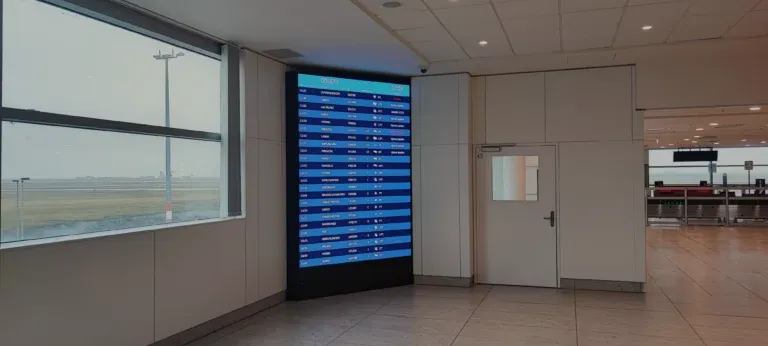
DOOH: The development of digital out-of-home advertising in 2026
DOOH in 2026: In recent years, advertising formats have undergone rapid transformations—from static formats to managed digital media channels.

What happened in the global advertising market in 2025?
The global advertising market continues to shift toward digital formats, while out-of-home advertising remains one of the most stable growth channels. According to international analytical agencies, total global advertising spend increases annually by an average of 5–7%, but it is digital formats that demonstrate the highest dynamics. Against this background, DOOH becomes a logical continuation of the digital transformation of the offline environment.
According to estimates from Western markets, DOOH advertising already accounts for more than one third of all investments in digital out-of-home advertising in major cities in the United States, Canada, and Western Europe. Growth is driven not only by the increase in the number of digital surfaces, but also by advertisers’ transition from static campaigns to flexible scenarios with frequent message changes. That is why advertising screens are increasingly viewed as a media asset rather than a one-time inventory item.
The Out of Home Advertising Association of America (OAAA) reports that digital formats are consistently growing at double-digit rates, and forecasts that by 2026 their share will reach approximately 40% of all out-of-home advertising spending. This trend is associated with increased demand for measurability, predictability, and the ability to centrally manage campaigns, which makes the digital model more attractive to large brands.
Scaling and network formation
Alongside the growth of investments, active consolidation of infrastructure is taking place. Operators are increasingly combining individual locations into DOOH networks, which makes it possible to sell advertising campaigns not individually, but in packages with guaranteed reach. This approach simplifies planning, makes inventory more understandable for agencies, and reduces operational costs for screen owners.
For advertisers, this means the ability to launch campaigns simultaneously across dozens or hundreds of locations with a unified display logic. At the same time, content can be adapted to regional specifics, time intervals, or location types—something that was previously difficult to implement in traditional out-of-home advertising.
Transition to automated models
The next stage of development is the implementation of programmatic DOOH campaigns, which transfer the principles of automated buying from digital channels into the physical space. In this scenario, impressions are purchased not “a month in advance,” but based on conditions: time, available inventory, and predefined campaign parameters.
As a result, digital out-of-home advertising is gradually acquiring the characteristics of a full-fledged media channel with predictable effectiveness. For the market, this means a change in the approach to planning, and for screen owners—a transition from selling surfaces to managing advertising traffic.
Programmatic DOOH and the ecosystem of automated buying
The transition to automated models in digital out-of-home advertising is associated with the development of pDOOH, which transfers the logic of the programmatic market from the online environment into the physical space. In this approach, impressions are no longer sold as fixed inventory “for a period,” but become a dynamic resource available for purchase in a near–real-time mode. For advertisers, this means greater flexibility, and for operators—more efficient screen fill rates.
A key role in this model is played by the interaction between SSPs and DSPs for DOOH. On the inventory owner’s side, the SSP is responsible for managing available impressions, access rules, and pricing, while the DSP allows advertisers to buy these impressions within a unified media strategy together with other digital channels. It is through this chain that DOOH is integrated into the overall programmatic ecosystem without losing control over quality and brand safety.
It is important that automation directly affects the measurement of DOOH effectiveness. Instead of abstract reach estimates, the market is gradually moving toward more transparent metrics: verified impressions, time intervals, contact frequency, and comparison of results across different locations. This allows advertisers to evaluate the contribution of out-of-home advertising to the overall media mix at a level close to digital channels.
The technical foundation of such scenarios is software for DOOH networks, which ensures stable screen operation, correct creative delivery, and data exchange with programmatic platforms. Without a unified management system and standardized protocols, integration with SSPs and DSPs would be impossible or overly fragmented.
A separate layer in this architecture is DOOH content management, which makes it possible to combine automated buying with editorial and brand control. Even in programmatic scenarios, operators retain the ability to define display rules, category restrictions, and content rotation logic, making digital out-of-home advertising manageable and predictable for all market participants.
The evolution of DOOH design and visual language
The evolution of digital out-of-home advertising is gradually shifting the focus from simple content playback to the creation of a visual experience. Whereas digital signage previously performed primarily an informational function, today it is becoming a full-fledged element of urban design that shapes the emotional perception of a brand. That is why design, light, depth, and motion are increasingly viewed as part of the advertising strategy rather than as a decorative addition.
Alongside classic 3D videos and large-scale posters on media façades of major cities, a trend toward anamorphic billboards is actively developing. These are special surfaces where the image “assembles” into a complete scene only from a specific viewing point. This approach creates a sense of presence and a visual illusion that is difficult to ignore and therefore increases engagement and message memorability.
Technically, the implementation of such formats is impossible without DOOH display solutions that combine hardware components, screen calibration, and complex content processing. A particularly important role is played by video wall software, which ensures precise image synchronization, correct geometry, and stable playback even on non-standard surfaces. As a result, advertising ceases to look like a set of separate screens and is perceived as a unified visual space.
Interactivity and augmented reality
Many advertisers are gradually coming to the conclusion that simply displaying a message is no longer sufficient. In conditions of information overload, the key factor becomes not the contact itself, but the duration and quality of interaction. That is why interactivity in DOOH is used as a tool for retaining attention rather than as an entertainment element.
One of the simplest yet effective ways of engagement is the use of QR codes. They make it possible to transfer contact from the offline environment to the digital one—to a website, a product catalog, an interactive game, or a dedicated promo page. In this scenario, the digital signage player performs not only a playback function but also becomes an entry point into a broader brand communication chain.
Special attention should be given to the phygital direction—the combination of physical and digital experiences. In marketing, this is expressed through virtual fitting rooms, online product customization, as well as synchronization of content on screens and users’ mobile devices. This approach makes it possible to create a seamless customer journey in which advertising does not interrupt the experience but logically continues it.
From an infrastructure perspective, phygital scenarios are closely connected with platforms such as a Supply-Side Platform, which make it possible to integrate interactive formats into the overall advertising ecosystem. This opens up opportunities not only to display creative content but also to collect interaction data, analyze audience behavior, and use these insights in subsequent digital campaigns. As a result, DOOH is gradually transforming from a visual channel into a full-fledged customer interaction tool.
The sustainability trend in Digital Out Of Home
Sustainability is gradually transforming from an additional argument into a full-fledged decision-making factor in the field of Digital Out Of Home (DOOH) and video advertising. The market is moving in two directions simultaneously: on the one hand, technological optimization of infrastructure; on the other, a shift in brands’ communication priorities. As a result, sustainable development becomes part of both the operational model and the visual language of advertising.
Advertising operators are increasingly investing in energy-efficient solutions. Modern LED billboards consume significantly less electricity compared to previous generations of screens, and automatic brightness adjustment allows displays to adapt to ambient lighting and time of day. This reduces the load on power grids while simultaneously extending the lifecycle of the equipment.
A separate direction involves eco-friendly solutions for digital signage, including the use of recyclable materials in constructions, a modular approach to component replacement, and the implementation of alternative power sources, particularly solar panels. For large networks, this is not only a matter of image but also a way to optimize maintenance and energy costs in the long term.
A key role in this process is played by a centralized video management system. It makes it possible to minimize unnecessary impressions, optimize broadcast schedules, and avoid content duplication across different locations. Centralized control reduces the need for physical interventions and service visits, which also has a positive impact on the network’s environmental footprint.
From the advertisers’ side, sustainability is increasingly becoming part of the creative strategy. Messages about responsible production, emission reduction, or support for sustainable initiatives are organically integrated into contextual DOOH advertising, where content adapts to location, time, and audience. For many consumers, such messages act as a marker of reliability and trust in the brand.
Let us now draw conclusions and practical guidelines. Advertising in 2026 is a combination of technology, creativity, and responsibility. Effective campaigns are less and less built solely on reach and increasingly on the quality of contact and the values that a brand communicates through the screen.
The market outlook is associated with deeper personalization, continued growth of the digital segment, and the development of automated placement models. In this environment, those who can combine data, context, and sustainable infrastructure approaches will benefit.
A practical step for businesses is to closely monitor the trends of tomorrow and adapt to them in advance. Sustainability in DOOH is no longer the future—it is a new standard that builds trust and long-term brand value.
Advision is a content management system for remote control, media planning of video and audio content broadcasting, and a supply-side platform for monetising advertising time. We also implement a Wi-Fi tracking system to measure quantitative indicators of the advertising audience. We help Digital Signage owners and DOOH advertising operators earn money from advertising, automate work processes, and build a reliable media infrastructure using AdTech and MarTech software solutions.
Contact us if you want to increase your profits and implement the latest technologies to solve your problems!