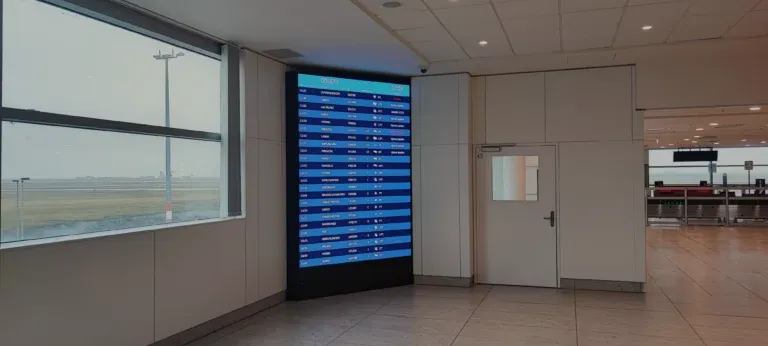
What is a video wall and 3 important benefits of its use according to OAAA
Video wall: Where the gaze meets meaning, space for a genuine impression appears.

A video wall (combined displays or TV panels) has long ceased to be a rare or exceptional solution — today it is becoming part of urban infrastructure, corporate environments, educational classrooms, and exhibition pavilions. It is not hidden or made into a background element. On the contrary, people look at it, interact with it, think through it, and make decisions through it.
A video wall is not just a large screen. It is a tool that combines image, data, motion, and sound into a single system of perception. It sets the tone of a space, shapes the focus of attention, and creates a sense of scale. This format works not somewhere on the periphery of the visual field, but at the very center of communication between a person and information.
In modern projects, indoor video walls are increasingly used as a key element of navigation, presentation, or analytics. They integrate organically into the interior, emphasize the architecture of the space, and at the same time remain a functional tool for everyday work with content.
This material examines what a video wall consists of, what types of solutions exist, where exactly they are used, and how they differ from ordinary screens. At the center of attention are logic, details, and practical value. After all, every image needs a stage, and a video wall becomes exactly the place where visual meaning sounds louder than words.
Definition: what a video wall is and how it works
A video wall is an impressive visual solution that forms a single panorama from multiple screens. It may consist of television panels or professional LCD modules combined into a single structure. Content in such a system is managed centrally and perceived as a unified image without noticeable breaks between elements.
A key role in the operation of a video wall is played by video wall software, which is responsible for signal synchronization, image scaling, and correct distribution of content across screens. It is precisely this software that allows the video wall to be treated as a single digital canvas, regardless of the number or format of panels.
If we look deeper, a video wall is not just a set of displays, but a full-fledged tool of visual communication. It transforms complex ideas into clear visual images, helps structure information, and makes it understandable at first glance. Without visual noise, without overload — only clear dynamics and logical presentation.
The powerful effect appears instantly. Scale inspires trust, and the integrity of the image engages the viewer in the process. In one case, these may be analytical dashboards or real-time maps; in another, emotional video content that enhances a brand or an event. It is precisely here that the digital signage system reveals its potential as a universal communication channel.
In real environments, video walls transform control rooms into command centers, educational spaces into interactive platforms, and exhibitions into cohesive visual stories. Thanks to the possibility of remote content management, teams can promptly update information, adapt display scenarios, and respond to changes in real time.
That is why video walls are increasingly considered part of modern advertising technologies and digital infrastructure as a whole. They make it possible to see more, understand faster, and act more precisely, combining aesthetics with practical value in a single solution.
What a video wall consists of
The composition of each solution directly depends on its purpose, however the basic architecture of a video wall remains universal. Regardless of scale or area of application, all elements work as a single mechanism, where technical precision is combined with visual expressiveness.
1. Displays and TV panels
The foundation of any video wall is formed by the modules from which the surface of the large screen is built. These can be indoor digital displays or separate LED modules — the choice is determined by viewing distance, lighting level, and the nature of the content.
TV panels with a thin bezel minimize visible seams, creating the impression of an almost seamless canvas. Light is evenly distributed across the surface, and the image looks cohesive and deep even at close viewing distances. The technology seems to disappear from the field of view, leaving only the content.
2. Controllers and signal processing processors
These components are responsible for the coordinated operation of the entire system. They connect the screens to each other, receive video streams from various sources, and ensure synchronized display. Without them, the image would lose its integrity, delays or distortions would appear. Inside is complex logic that simultaneously aligns colors, scales content, and maintains stable operation over long periods of time. This is the technical core that sets the rhythm for the entire visual process.
3. Software control environment
This is where the hardware system turns into a convenient tool for everyday work. Software for digital screens allows the creation of layouts, setting display scenarios, and working with different content formats without complex technical operations. The interface is usually intuitive, yet flexible, making it possible to adapt the video wall to specific tasks — from informational messages to complex visual compositions.
4. Signal sources and players
Separate hardware or built-in solutions are used for content playback. A digital signage player ensures stable delivery of video, graphics, or streaming data, supports the required formats, and allows quick changes of display scenarios. It is responsible for ensuring that content looks equally high-quality on all screens regardless of the complexity of the composition.
When all these components are configured correctly, a video wall ceases to be just a set of technologies. Scale and clarity transform information into a clear and convincing picture, where every element works in a unified visual rhythm. In this format, video walls for advertising become a full-fledged stage for a brand, an idea, or a message.
Types of video walls and their features
LED and LCD video walls
The choice between LED and LCD solutions is always based on the context of use. LED constructions are formed from individual modules and are known for their high brightness. Large LED screens are easily readable from long distances, do not lose color saturation even under intense lighting, and are suitable for spacious halls, atriums, or large-scale public installations. They create a strong emotional effect and visually dominate the space.
LCD video walls are built from several professional panels assembled into a single plane. Their key advantage is high detail and accurate color reproduction. Such solutions are often used in meeting rooms, control rooms, or office spaces, where it is important to correctly display text, tables, or analytical data. Thanks to thin bezels, the image looks structured and clear even during prolonged viewing.
Both types of video walls are effective in their respective scenarios. The final choice depends on the installation location, operating mode, and the nature of the content. It is precisely the combination of technical parameters and centralized content management that allows a video wall to operate stably, look convincing, and remain convenient to use throughout its entire life cycle.
Seamless and narrow-bezel
The bezel directly affects the perception of the image. The thinner it is, the less noticeable the transition between individual modules becomes. That is why seamless solutions are valued where the integrity of the visual image is important. When the boundaries almost disappear, the screen is perceived as a single surface, and the viewer’s attention is focused not on the structure, but on the content.
Such video walls are often used in galleries, advertising spaces, and studios, where the image must function like an artistic canvas. The visual flow moves smoothly, without breaks or pauses, and the rhythm of the image remains calm and composed. The technology seems to step into the background, allowing the idea to sound clean and confident.
Narrow-bezel solutions offer a balance between aesthetics and cost. They form a clear structure in which the image is read evenly and without distortion. The installation of such systems is more flexible, allowing the configuration to be adapted to a specific space or changed over time. If necessary, the structure can be scaled, reconfigured, or integrated into an existing interior without losing the integrity of the composition.
LED video walls work especially expressively in this format, where the geometry of the modules and the precision of the joints create a sense of a monolithic surface. Lines align correctly, corners preserve the logic of the space, and the visual emphasis consistently remains on the image rather than on technical elements.
Areas of application of video walls
Operational centers and control rooms
In environments where full immersion in data and constant visual control are required, a video wall becomes a key working tool. Control rooms in transport, energy, or security systems use it not as a large monitor, but as a consolidated picture of the entire infrastructure in real time. Maps, flows, video surveillance, and analytical indicators are combined into a single space without loss of detail.
Information is presented in layers, forming a living scheme of processes. Each fragment has its own place and purpose, and the overall composition allows the situation to be assessed quickly. Here, dynamic content and video content are not simply displayed, but function as tools for analysis and control, changing along with events.
In such conditions, a video wall is a working environment where time is decisive. Fast switching between sources, high clarity, and display stability form a clear rhythm of work. One segment may show critical areas, another the distribution of resources, and another external factors affecting the situation. When visualization is always in front of the eyes, complex processes become understandable and manageable.
Retail and exhibition halls
In showrooms, a video wall immediately attracts the eye and shapes the first impression. It demonstrates a product, an idea, or a mood without unnecessary explanations, working on the level of imagery. Content deployed across an entire wall creates a sense of presence and immersion, thanks to which the space ceases to be just a location — it turns into a stage for the brand.
In shopping malls, a wall of screens stops being static advertising. It adds movement, depth, and interaction dynamics. The image changes, draws attention to key zones, and gently guides the flow of visitors. People stop, observe, linger near the screen, and it is at this moment that contact arises between the idea and the viewer. Light, color, and scale work together, not imposing a message, but confidently leading toward it.
Management of such an environment is usually carried out through a CMS application, which allows display scenarios to be changed quickly, content to be adapted to the time of day or a specific event, and multiple zones to be managed simultaneously. This makes the video wall a living tool rather than a fixed advertising medium.
Education, healthcare, and corporate offices
In educational spaces, a video wall gradually replaces the traditional board. Charts, diagrams, broadcasts, 3D models, and maps appear on it, turning the learning process into a visual dialogue. Information is presented clearly, and complex topics are perceived faster thanks to the scale and clarity of the image.
In corporate environments, video walls are used for strategic dashboards, presentations, video conferencing, and collaborative team work. They combine different sources of information within a single field of view, reducing attention loss and accelerating discussions. In healthcare, such screens are used to demonstrate operations, diagnostic data, and consultations, making complex information more transparent and understandable for specialists.
It is precisely the synchronization of advertising content and information flows that allows such systems to operate coherently, regardless of the number of screens or data formats. In this case, the video wall becomes a language of visual thinking that unites knowledge, processes, and communication within a single space.
Benefits of using video walls
The main advantage of video walls is scale and the integrity of information perception. When multiple sources are combined into a single visual surface, the user’s attention does not fragment between separate screens. This directly affects the speed of perception and the quality of decision-making.
According to Nielsen research, large digital screens attract 3–4 times more visual attention than static posters or printed media. The average contact time with content on a video wall increases by 30–45%, which is especially critical for retail and public spaces.
Configuration flexibility is another key advantage. A video wall allows images to be displayed across the entire surface or divided into functional zones. According to Samsung Business Insights, multi-zone video walls increase the effectiveness of presentations and working meetings by up to 25%, as all information is located within a single field of view.
Brightness and image clarity also have a measurable effect. LED and professional LCD solutions maintain content readability even under challenging lighting conditions. According to Intel research, clear data visualization on large screens reduces the number of errors during information analysis by 15–20% in control rooms and operational centers.
The impact on audience behavior is worth highlighting separately. According to OAAA, digital video walls in retail spaces provide the following important benefits:
– increase the likelihood of impulse purchases by 18–25%
– increase brand recall by an average of 40%
– increase dwell time near the screen area by up to 30%
An important component is digital advertising analytics. Modern video walls can be integrated with data collection systems, making it possible to measure the number of contacts, viewing duration, and the effectiveness of display scenarios. According to Deloitte estimates, companies that use analytics in digital visual networks increase content effectiveness by 20–35% compared to those that operate without measurement.
An additional advantage is durability and operational stability. Professional displays for video walls are designed for 24/7 operation, with a service life exceeding 50,000–100,000 hours. This helps reduce maintenance and equipment replacement costs in the long term.
A video wall is more than a collection of screens or a technical solution. It shapes a space in which information becomes clear, noticeable, and convincing. Through scale, rhythm, and precision of presentation, a video wall combines data, emotion, and meaning into a single visual language.
That is why video walls find their place in business, education, healthcare, and public spaces. They help explain complex things faster, interact with audiences more effectively, and make decisions based on a clear and visual picture. In a modern environment where attention has special value, a video wall becomes a tool that works not in the background, but at the center of events.
Advision is a content management system for remote control, media planning of video and audio content broadcasting, and a supply-side platform for monetising advertising time. We also implement a Wi-Fi tracking system to measure quantitative indicators of the advertising audience.
We help Digital Signage owners and DOOH advertising operators earn money from advertising, automate work processes, and build a reliable media infrastructure using AdTech and MarTech software solutions.
Contact us if you want to increase your profits and implement the latest technologies to solve your problems!