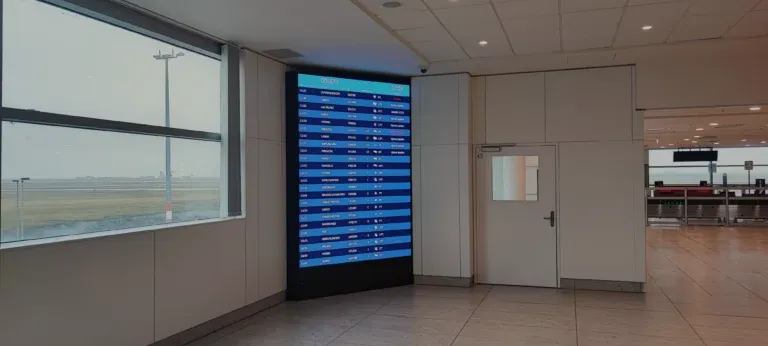
Digital screens transform the educational space and help accomplish 8 tasks
Digital screens: Greater engagement and faster information delivery for young people who are accustomed to digital communication.

Digital signage in educational institutions is a modern communication channel with pupils, students, and teachers that corresponds to the pace and format of information perception of the new generation. It forms a unified information environment and allows important messages to be delivered quickly in a clear and visually appealing form.
The era when the main means of audio information in schools was radio, and visual communication was limited to notice boards, wall newspapers, or printed posters, has gradually faded into the past. The modern educational space requires dynamic and flexible tools for presenting information.
Today, both schoolchildren and students cannot imagine their everyday life without digital devices. Information presented through digital advertising on screens is perceived much faster and more effectively than traditional printed media, especially when it comes to schedules, events, announcements, or internal news of the institution.
The use of multimedia solutions, such as LED video walls, makes it possible to create bright visual accents in lobbies, corridors, and common areas. They attract attention, enhance message memorability, and create a sense of a modern, technologically advanced environment.
An important role in this ecosystem is played by Digital Signage management, which ensures centralized content updates, flexible scheduling of displays, and adaptation of messages for different audiences. Thanks to this, the administration can quickly respond to changes and maintain the relevance of information.
Technical stability and playback quality are ensured by an Indoor TV player, which is responsible for the uninterrupted operation of screens within the educational institution’s premises. This allows digital signage to be used as a reliable daily communication tool rather than a one-time solution.
Overall, such solutions organically fit into the concept of modern advertising technologies, where information is not imposed but becomes part of the educational environment, helping to navigate, interact, and stay engaged in the life of the institution.
Value for the owner
The implementation of digital signage contributes to the promotion of an educational institution as modern and progressive. It shapes a positive image, demonstrates openness to innovation, and increases the attractiveness of the institution for prospective students and their parents.
Digital screens make it possible to significantly reduce printing costs and promptly update information without additional financial expenses. In addition, there is an opportunity to generate additional income from placing third-party advertising or partner materials.
Value for management
For administration, digital signage is a mobile and convenient channel of interaction with the teaching staff and students. It simplifies informing about changes in the educational process, events, meetings, and internal initiatives.
Screens can be used to highlight the achievements of teachers and students, as well as to visually present educational programs, plans, admission conditions, and other important aspects of the institution’s activities.
Value for the student
For pupils and students, digital signage is an attractive and clear format for receiving information that corresponds to their style of perception. Dynamic content makes the educational environment more lively and engaging.
They open up opportunities for interactive participation in the life of the institution: online polls, quizzes, surveys, or observing events in real time. This increases engagement and fosters a sense of belonging to the community.
Digital signage in the educational space
Digital signage is gradually becoming a full-fledged part of the educational environment. It forms a unified information space in which pupils, students, teachers, and parents receive up-to-date information quickly and in a convenient format. This approach meets modern audience expectations and increases the effectiveness of internal communication.
Thanks to centralized solutions, an educational institution receives a flexible tool for informing, engaging, and interacting that works every day and does not require complex technical maintenance. Let us consider 8 tasks that can be accomplished using Digital Signage.
1. Information channel
Digital screens make it possible to broadcast important information in real time. Changes in schedules, notifications about seminars, olympiads, internal events, or extracurricular activities become visible to the entire audience without additional effort. A digital notice board with information about general institutional events, study schedules, greetings, and announcements works especially effectively in educational spaces. This format is convenient for perception and helps structure the daily flow of messages and save on printing paper-based information.
2. Entertainment and interactive channel
Multimedia content significantly increases interest in information. Slides, images, and videos make it possible to present educational and reference materials in a dynamic and modern format. The integration of QR codes in advertising and educational materials opens access to additional resources: online pages, feedback forms, or schedules. This creates a bridge between the offline space of the educational institution and digital services.
3. Analytics and feedback
Digital signage can be not only a broadcasting channel but also a source of analytics. An educational institution gains the ability to collect data on interest in specific programs, events, or services. By analyzing audience behavior, as well as comments and suggestions from teachers, parents, and students, the educational process can be promptly adjusted. This approach makes it possible to implement personalized content for clients of educational services and improve the overall quality of interaction.
4. Advertising and image channel
Digital screens are an effective tool for presenting an educational institution. They help communicate information about educational programs, student achievements, participation in competitions, and the results of admission campaigns. Special attention can be paid to announcements of additional courses, workshops, and trainings, using digital menus and information for clients as a convenient navigation format for visitors and prospective students. It is also possible to place commercial advertising relevant to the audience.
5. Corporate identity and a unified visual approach
Digital signage makes it possible to maintain a unified style throughout all premises of the educational institution. Colors, fonts, and graphic elements form a recognizable image and strengthen the institution’s brand. Adherence to corporate identity on every screen creates a holistic impression and emphasizes the modern level of organization of the educational space.
6. Monitoring and stability 24/7
Reliable software for screens ensures continuous content playback even in the event of internet connectivity disruptions. Playlists are played automatically, without staff intervention. Continuous monitoring makes it possible to respond quickly to technical failures and maintain stable operation of the entire system in non-stop mode.
7. Convenient system management
Centralized content management for digital signage makes it possible to update information remotely and synchronously across all screens. Administrators can change materials in just a few clicks without being physically present at the educational institution. This approach significantly saves time and simplifies work with large screen networks in schools and universities.
8. Individual approach to each audience
Digital signage creates a comfortable environment for communication between principals, teachers, students, and parents. The interactive format promotes open dialogue and increases the level of trust. Thanks to flexible content display scenarios, each group receives relevant information at a time that is convenient for them.
System benefits
The use of digital screens in a corporate environment is not a decorative solution but a tool that directly affects communication efficiency, decision-making speed, and team engagement. The company gains a unified information space that operates continuously and can be scaled.
According to Western studies in the field of internal communications, visual presentation of information increases message recall by 40–60% compared to text mailings and internal emails. That is why digital screens are increasingly becoming the foundation of corporate communications.
Internal culture and engagement
Digital solutions help form a recognizable and lively culture of internal communication. A company can speak about its values not formally, but through the language of visual content, which is easy to perceive in the work rhythm and does not overload employees.
The use of interactive formats increases attention to key messages and stimulates team participation in internal processes. The interactive digital advertising format makes it possible to turn passive information viewing into interaction, creating a sense of involvement and open dialogue between different departments.
Synchronization and controllability
One of the key advantages of digital screens is the ability to centrally control information. Remote content management makes it possible to update messages simultaneously in the head office, regional divisions, and branches without delays.
This is especially important for companies with a distributed structure, where it is critical to:
– adhere to unified standards
– respond quickly to changes
– synchronize the actions of different teams
In this process, a content management system (CMS) plays a fundamental role, ensuring planning, automated scheduling, and control of displays without manual routine.
Impact on business metrics
Corporate digital screens work not only for HR and internal processes but also for commercial results. In showrooms, sales offices, and customer areas, they strengthen the impact of offline sales by building trust and an expert perception of the brand.
Analytics show:
– up to a 20–30% increase in attention to products at physical touchpoints
– an increase in time spent interacting with the brand
– a higher level of offer recall
Digital content acts as an amplifier of arguments in the real space.
Automation and efficiency
Modern corporate screens operate in combination with intelligent content display scenarios. Thanks to advertising automation, information is updated based on events, time, or business logic without constant manual intervention by teams.
This reduces the workload on marketing and HR departments, makes the management process predictable and stable, and allows the system to be scaled without losing control over the quality of communication.
Problem and solution
Managing a network of digital screens often seems like a complex and expensive process, especially when it comes to a distributed infrastructure consisting of dozens or hundreds of displays. Many companies face barriers already at the implementation stage, which slows down the development of communication in the physical space.
The greatest difficulty lies not only in the cost of equipment but also in associated expenses — setup, support, software updates, and the involvement of separate specialists.
Main problems
The high cost of deploying a distributed screen network is often combined with the need to pay for the work of technical specialists responsible for system setup and further management. This significantly increases the overall project budget.
The process of installing and configuring equipment can take several weeks. During this time, the business does not receive any practical benefit from the investment, and the launch of communications is delayed.
A separate limitation is the need for an in-house server. Its maintenance, security, and stability require additional resources and competencies.
In addition to this, there are paid software updates, as well as the need to form an internal team or involve contractors to create designs, templates, and specialized applications.
As a result, a system that was supposed to simplify communication and enhance the visualization of offers and events turns into a complex and costly tool.
Effective solutions
A modern approach to Digital Signage involves the use of compact and affordable solutions. A small mini PC, such as an Android set-top box, easily connects to any HD screen with an HDMI input and does not require complex infrastructure. At the same time, setup and technical support are provided free of charge.
Installation of the entire system takes only one day. The business can start broadcasting content almost immediately after connection, without lengthy preparatory stages and downtime.
Abandoning an in-house server becomes possible thanks to the cloud-based SaaS model. Content is stored and managed in a secure environment, while synchronization of advertising content between screens occurs automatically and without delays.
Flexibility and scalability
Regular updates of the platform and devices are provided free of charge, which guarantees up-to-date functionality and stable system operation without additional costs.
If necessary, the company can use additional services — from application development to building a content strategy. This makes it possible to adapt the system to specific business tasks and usage scenarios.
Such solutions are of particular value in retail, where interactive displays for customers become a tool not only for informing but also for active interaction, increasing engagement and the quality of the customer experience.
As a result, modern digital solutions allow educational institutions to focus on what matters most — high-quality communication with pupils, students, and teachers. Ease of implementation, centralized management, and flexibility of scenarios make digital screens a convenient tool for informing and interaction in the educational environment. Such systems help create a clear, modern, and open space in which information works to support the learning process and the development of the institution.
Advision is a content management system for remote control, media planning of video and audio content broadcasting, and a supply-side platform for monetising advertising time. We also implement a Wi-Fi tracking system to measure quantitative indicators of the advertising audience. We help Digital Signage owners and DOOH advertising operators earn money from advertising, automate work processes, and build a reliable media infrastructure using AdTech and MarTech software solutions.
Contact us if you want to increase your profits and implement the latest technologies to solve your problems!