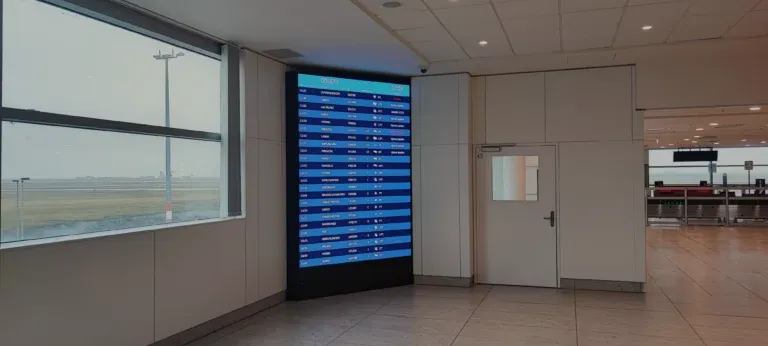
Seasonal DOOH advertising campaigns and strategies prepared 3 months in advance
Multichannel reach and more precise targeting for DOOH advertising require technological preparation.

November hasn’t even started yet, and major retailers are already drafting their Black Friday budgets. This isn’t paranoia — it’s experience. While some businesses prepare for months, others rush to make banners a week before launch and buy remnant placements at twice the price. The result is predictable.
Digital advertising on screens offers a different approach. Digital Signage and DOOH are not just new media formats — they represent a different logic for working with seasonal demand: plan in advance, launch at exactly the right moment, adjust in real time based on actual data rather than gut feeling. Below is what this looks like in practice.
1. Plan your campaign around seasonal peaks
Marketers who start preparing 2–3 months in advance have a significant edge: they have time to test several creative variants, compare placement prices, and book the best locations before demand for them rises. Those who start a week out are already choosing from what’s left.
A Digital Signage CMS platform solves one of the main problems with seasonal launches — the human factor. Content is prepared in advance, publication is scheduled for a specific date and time, and at the right moment the campaign goes live without any manual intervention. This is especially important when managing a network of dozens or hundreds of locations.
What to do at the planning stage:
— Identify key seasons for your niche. For petrol stations, this might be the start of the dacha season or the winter period of increased demand for antifreeze. For restaurants and cafés — Valentine’s Day, the corporate season in December, summer terraces.
— Gather analytics from previous years’ campaigns: which promotions generated response, which locations drove the most traffic, what display frequency was optimal.
— Prepare several creative variants for different scenarios — weather conditions, time of day, audience type.
— Agree on the budget and allocate it across channels in advance: Digital Signage, Indoor TV, programmatic DOOH. It’s better to review the allocation weekly based on current analytics rather than fixing it once and for all.
Launching 1–2 weeks before the season peaks gives you time to reach the audience while competition is still below its maximum and consumers haven’t yet made their final decisions.
2. Dynamic content as a competitive advantage
Imagine this: it’s minus ten outside, and there’s an ad for summer sandals on the billboard. That’s exactly what a static banner ordered three months ago and forgotten looks like. One layout, one message, all season — regardless of weather, time of day, or who’s standing in front of the screen.
Dynamic content and video content solve this problem. The temperature drops below zero — the platform automatically pulls in the weather forecast and switches the screen to winter clothing ads. Three days left until the sale ends — a countdown timer appears. Friday evening — the offer changes to suit the evening audience. No manual intervention, no belated edits.
For petrol stations, updating fuel prices in real time is no longer an option — it’s a basic requirement. The customer sees the current price before even entering, makes a decision faster, and queues get shorter. For restaurant chains — instant updates to digital menus when a new item is added or a dish runs out.
Real-time advertising campaigns are no longer the privilege of large brands with large budgets. Digital Signage platforms with dynamic trigger support are accessible even to mid-sized businesses, and the effect is noticeable from the very first season.
3. Geolocation targeting and hyperlocal advertising
An advertising banner in a residential neighbourhood and the same banner near a shopping centre are effectively two different advertising formats, even if they display the same image. The audience is different, the mindset is different, the readiness to purchase is different. Geolocation campaigns take this into account from the very start.
Geolocation targeting in the DOOH (Digital Out-of-Home) format allows you to tie an advertising message to a specific place and time:
— In summer — advertising near beaches, parks, and leisure areas. Soft drinks, sun protection products, sportswear.
— In autumn and winter — a focus on shopping centres, where people are looking for gifts and seasonal goods. Shopping centre media facades become the main advertising platform for December.
— In spring — locations near garden centres, DIY stores, and fitness clubs.
Programmatic DOOH campaigns automate this selection: the advertiser sets the parameters — geography, time of day, location type — and the algorithm purchases impressions on the relevant screens. The budget goes where the target audience is, rather than being spread across all available surfaces.
A separate tool for seasonal marketing is contextual DOOH advertising. It responds not only to location, but also to the external context: weather, temperature, local events. A snowstorm begins — tyres or shovels appear on screens before most competitors have had time to react. Forecasters are predicting a heatwave — a supermarket chain launches soft drink advertising in advance. It is precisely this speed of response that is the main advantage of the digital format over traditional outdoor advertising.
4. Personalised digital advertising and audience segmentation
According to Nielsen, consumers are 76% more likely to respond to advertising that matches their current context — time, place, interests. At the same time, irrelevant advertising is not simply ignored — it creates a negative impression of the brand. Ads for winter boots in August or an offer for a summer camping trip in January costs not only the money spent on placement.
Personalised content for customers in Digital Signage is built on several levels. Time-based — different content for morning, afternoon, and evening: coffee and breakfasts in the morning, evening meal deals or “after work” promotions in the evening. Seasonal — automatic content changes according to the time of year or a specific holiday. Behavioural — at locations with Wi-Fi monitoring or analytics cameras, the platform identifies the demographic profile of the audience and selects relevant ads accordingly.
Personalisation of advertising content directly affects impulse purchases and increased conversions. A customer who sees a relevant offer at the right moment makes a decision faster — and more often in favour of the brand that “anticipated” their need.
In the HoReCa segment this principle is especially pronounced. A digital menu board in a café that shows discounted breakfasts in the morning and switches to a business lunch offer at midday directly affects the average transaction value. Real-time price and menu updates eliminate the need to print new menus every time the range changes — and give the establishment the flexibility that was previously available only to large chains.
5. Multichannel approach and message synchronisation
The average buyer sees an advertising message 7 times before making a purchase. This doesn’t mean showing the same banner seven times — it means the brand needs to be present across multiple touchpoints simultaneously. A billboard on the way to work, a social media post in the evening, a screen in the retail space the next day. If all of them are telling the same story — the result exceeds the sum of its parts.
Digital Signage fits naturally into a multichannel strategy. QR codes on screens take passers-by directly to the promotion page or app. Synchronisation between Indoor TV in the retail space and outdoor LED screens amplifies the brand’s sense of presence. And advertising automation through a single management platform makes it possible to launch a campaign simultaneously on hundreds of screens across different cities — without manually configuring each location.
Brand recognition increases precisely through this consistency. When the brand’s colours, typeface, and slogan are identical on an outdoor LED screen, in social media, and in an email newsletter, the brand is remembered even without conscious attention from the consumer. During a season when the advertising noise from competitors rises sharply, it is the coherence of communication that allows a brand to stand out.
6. Campaign analytics and real-time optimisation
Advertisers joked for decades: “Half the advertising budget is wasted — but no one knows which half.” With traditional outdoor advertising, this isn’t a joke — it’s literally true. How many people saw the billboard? Which of them walked into the store? These questions went unanswered. The digital format made them measurable.
Digital Signage platforms and programmatic DOOH track the number of impressions, reach by time and location, and audience activity near the screen. According to OAAA, digital DOOH generates 400% more measurable interactions compared to traditional outdoor advertising formats. Media planning based on this data makes it possible to reallocate the budget towards the locations and time slots with the highest performance, replace creative that isn’t generating response without waiting for the end of the campaign, and compare results across different seasons to build a knowledge base for future launches.
Campaign analytics are particularly valuable broken down by hour of day and day of week. For a shopping centre, peak engagement often falls on Friday evenings; for a petrol station — Monday mornings. This data isn’t obvious until you measure it, but after just the first season it allows you to significantly improve the performance of the next campaign — with the same budget.
7. Urgency and visual hierarchy in seasonal content
The sense of limited availability is one of the most powerful triggers in marketing. In the digital environment, however, this technique takes on new forms.
On Digital Signage screens, urgency is expressed through:
— A countdown timer to the end of a promotion, which updates automatically.
— Dynamic display of remaining stock (“Only 5 units left”).
— An emphatic call to action in outdoor advertising — large, high-contrast, with a clear deadline.
Visual presentation of offers and promotions also matters: colours, typefaces, and composition should match the season. Warm tones and festive graphics for winter holidays, bright colours and dynamic transitions for summer sales. A coherent visual style is recognisable even at a glance.
That said, it’s important not to overdo the urgency. If every promotion is presented as a “last chance”, the audience starts ignoring it within a few weeks. The approach that works looks different: a steady, moderate brand reminder combined with short bursts of pressure on key days — three days before the promotion ends, 24 hours out, and on the final day. Digital Signage allows you to automate this schedule and avoid overloading the audience.
The outcome is decided before the season starts
The next seasonal peak is already in the calendar. The only question is who will be ready for it.
Geolocation targeting, dynamic content, real-time campaign analytics — all of this stopped being the preserve of large brands long ago. Small and mid-sized businesses work with the same tools. And if your competitors already understand this, the “we’ll sort it out later” moment may turn out to be a costly decision.
Advision is a content management system for remote control, media planning of video and audio content broadcasting, and a supply-side platform for monetising advertising time. We also implement a Wi-Fi tracking system to measure quantitative indicators of the advertising audience. We help Digital Signage owners and DOOH advertising operators earn money from advertising, automate work processes, and build a reliable media infrastructure using AdTech and MarTech software solutions.
Contact us if you want to increase your profits and implement the latest technologies to solve your problems!