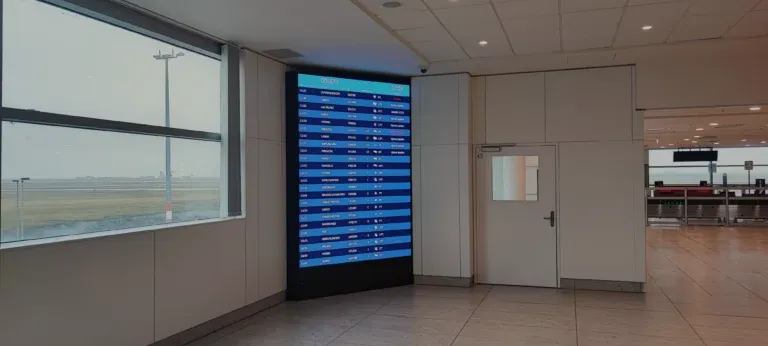
Digital Signage — solution №1 for corporate standards
The Digital Signage system today is one of the most effective tools for visual communication with clients.

Proper integration ensures a dynamic connection between the company’s presentation and client expectations, allowing harmony between visual style and strategic goals.
It is important that the adaptation of digital solutions corresponds to the specific tasks of the business. Every detail — from design to content type — must be aligned with corporate standards, because this creates an unforgettable experience and strengthens the impact of brand messages.
Why is adaptation to corporate standards important?
The main goal of using Digital Signage is to emphasize the uniqueness of the company and to convey its mission and values to the consumer. When solutions are truly integrated into the brand system, the brand becomes more noticeable, and the connection with the audience — long-term.
– Unified brand concept. Consistency of style and content helps form a holistic perception of the company and fix its identity in the minds of the audience.
– Recognizability. Comprehensive adjustment of color scheme, fonts, and graphics according to corporate norms creates a visual uniqueness that can be easily associated with the brand.
– Precision of positioning. Well-chosen tone, text structuring, and choice of format strengthen the delivery of the company’s key messages and values.
Synergy of online and offline channels
A high-quality approach to designing Digital Signage ensures their compliance with the corporate styling of physical stores or advertising signs. This emphasizes the professionalism of the brand, demonstrates attention to detail, and creates a unified informational environment for the client.
Effect for business and clients
Coordinated use of screens for advertising and branded content allows standing out among competitors and raising the service level. Clients receive not only relevant information but also aesthetic satisfaction from a modern, stylish presentation.
Thoughtful adaptation promotes loyalty growth, reinforces a positive impression from interaction with the company, and helps build a strong connection between the brand and the audience.
How to adapt Digital Signage to corporate standards
Adapting Digital Signage to the corporate style of a brand is a complex and multi-level process that requires close interaction between marketing, design, and IT teams. Before starting practical work on the system, it is important to clearly understand not only the company’s visual standards but also their role in shaping the overall concept and brand perception by external audiences. Only then can an effective platform be created that works towards achieving your commercial goals.
1. Analysis of corporate style
The primary task is a deep study and adherence to the brand standards of your company. Examine in detail the style guides, carefully review the palette of primary and secondary colors, the fonts selected by the company, and the approach to visuals, photos, and icons. This is the foundation without which the coordinated functioning of any advertising screen within the brand structure is impossible. Taking into account even the smallest details will help make the content more holistic and professional.
2. Taking marketing strategy into account
The brand strategy should be reflected in all content broadcasted on the company’s interactive solutions. This concerns both corporate slogans and missions, as well as current marketing campaigns, special promotions, or advertisements. Content should be integrated so that a client, interacting with the business online, offline, or through informational channels, feels the unity and logical connection of all messages. When planning content, pay special attention to current promotions and competitor reaction.
3. Researching the target audience
The success of adaptation also depends on a deep analysis of the needs, interests, and expectations of your audience. It is important not only to study demographic data but also to understand the behavior of target groups and the peculiarities of information consumption through corporate channels. This allows the creation of varied and relevant content capable of effectively influencing the decision-making of potential clients.
4. Practical adaptation and design
At this stage, you have to develop personalized scenarios using graphic elements that emphasize the style and uniqueness of the brand. Think through the design of each surface: the selection and placement of logos, adaptation of colors and images. The proper use of typography, text size, and style determines the ease of perception of information. Do not forget to consider technical limitations: different resolutions and parameters of devices in your network.
5. Integration of software and CMS
If the functionality of standard solutions is insufficient, it is recommended to introduce software for managing Digital Signage. Such platforms make it possible to automate displays, structure content, and conduct detailed monitoring of all information points. A professional CMS (Content Management System) is an additional tool for centralized management and flexible role configuration. Thanks to this, it is possible to quickly update advertising materials on dozens or even hundreds of screen devices.
6. Use of Android media players for scaling
For extended company networks, it is advisable to use Android media players. They simplify the management of the information flow, reduce the time needed to update content, and provide ease of integration with software for managing Digital Signage. This way, an effective management system can be organized, taking into account the specifics of each device.
7. Quality and compliance control
The quality of materials and their compliance with corporate standards must be constantly controlled. This includes both automated checks by appropriate services and regular monitoring by company employees. It is important to ensure a uniform appearance of materials at all broadcast points — only in this way will you maintain trust in the brand and provide a stable image, improving the experience for clients.
Examples of successful adaptation of Digital Signage solutions
International experience shows that competent implementation of Digital Signage solutions significantly enhances branding strategy and noticeably increases the level of customer engagement. In 2025, according to recent data from Grand View Research and a number of recent industry reviews, the global Digital Signage market is estimated at approximately $28.8 billion and, according to forecasts, may grow to almost $46 billion by 2030. In 2025, the sector demonstrates steady growth with an average annual rate exceeding 8%. More than 50% of retail operators in Western Europe and the USA actively use such technologies to optimize customer experience and automate communication. The use of innovative Digital Signage has become a marker of a modern approach to service and market differentiation.
McDonald’s and large LED screens
McDonald’s in many countries has integrated large LED screens for dynamic display of menus, special offers, and current advertising messages. Bright panels allow not only instant updating of the dish assortment but also adapting content to the peculiarities of a specific location or time of day. For the brand itself, this has become not just an information tool — Digital Signage and client information increase transparency and create an atmosphere of openness, which contributes to a positive perception of the brand. The experience of McDonald’s proves that proper use of Digital Signage solutions ensures stable growth in the number of repeat purchases.
Coca-Cola: media facades and image
Coca-Cola effectively uses media facades for shopping malls, as well as large Digital Signage that have become part of the urban landscape in many megacities. Bright screens broadcast vividly designed advertising campaigns, where the iconic bottle and the recognizable red color of the brand remain the central visual element. The media facade not only attracts attention but also allows the brand to communicate with consumers in large urban spaces. This way, Coca-Cola increases recognition and provides interactive contact in high-traffic areas. Studies conducted in the USA show that such solutions increase the effectiveness of advertising campaigns by 20-30%.
Apple: harmony of design and technology
Apple is justly renowned for minimalism and attention to detail, and these principles are clearly reflected in the use of Digital Signage solutions in the company’s stores worldwide. Modern digital displays show new releases, product information, as well as interactive hints for visitors. Thanks to this, every Apple store is perceived as an innovative space of the future, where technology is inseparable from a high level of service. Thoughtful integration of information systems allows customers to independently find the necessary products or easily consult with staff through interactive panels. This not only emphasizes the status of the brand but also creates a unique customer experience.
Benefits for business
According to Statista, 80% of shoppers remember information seen on digital menus or advertising screens more quickly than on printed notices. The use of innovative IT infrastructure focused on digital menus and customer information enables businesses to reduce costs on operational updates while increasing engagement levels. Western analysts note that interactive panels at points of sale can increase conversion by up to 30%, and the use of large LED screens and media facades in shopping malls opens up opportunities for large-scale advertising campaigns and attracting new audiences. Leading brands show that investments in high-quality Digital Signage solutions bring quick and stable results for modern business.
There is also a useful technology for retail, such as Android set-top boxes
An Android set-top box is a compact and multifunctional device based on the Android operating system that easily integrates with any modern screen or multimedia panel. It transforms an ordinary display into an intelligent platform for digital content management, opens access to flexible marketing tools, and provides centralized control of all screens in the network. Such devices are ideal for businesses that strive to respond quickly to changes and effectively communicate with customers through Digital Signage.
Main features of Android set-top boxes for retail:
– Remote content update (video and graphic) at all retail points.
– Flexible scheduling of displays depending on time, season, or marketing objectives.
– Audio-visual integration: multichannel broadcasting of video, music, and voice messages to create a unique customer experience.
– Interactive features: support for QR codes, promotions, and integration with mobile apps.
– High level of data security and individual access settings for each location.
– Easy integration with POS terminals, CRM, and other IT solutions for retail.
Thanks to the integration of modern Digital Signage solutions, the retail business gains powerful tools for effective interaction with customers and forming a recognizable, up-to-date brand. A systematic approach to audio-visual communication opens new opportunities for service development and strengthens competitive advantages in the market.
Advision is a content management system for remote control, media planning of video and audio content broadcasting, and a supply-side platform for monetising advertising time. We also implement a Wi-Fi tracking system to measure quantitative indicators of the advertising audience. We help Digital Signage owners and DOOH advertising operators earn money from advertising, automate work processes, and build a reliable media infrastructure using AdTech and MarTech software solutions.
Contact us if you want to increase your profits and implement the latest technologies to solve your problems!