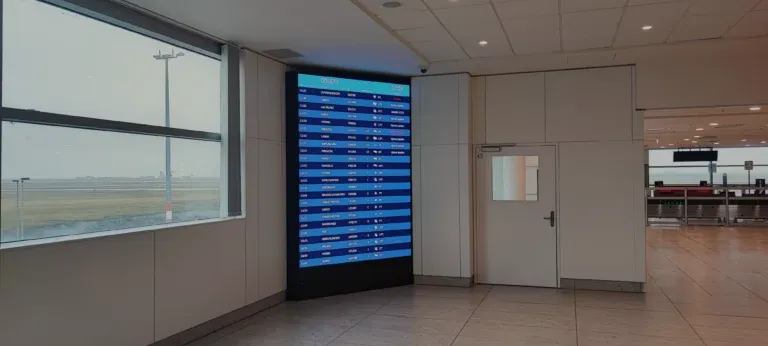
Digital Signage player: 5 recommendations for choosing screens
Digital Signage: In this article, we will provide practical recommendations for selecting a reliable solution for screens and content.
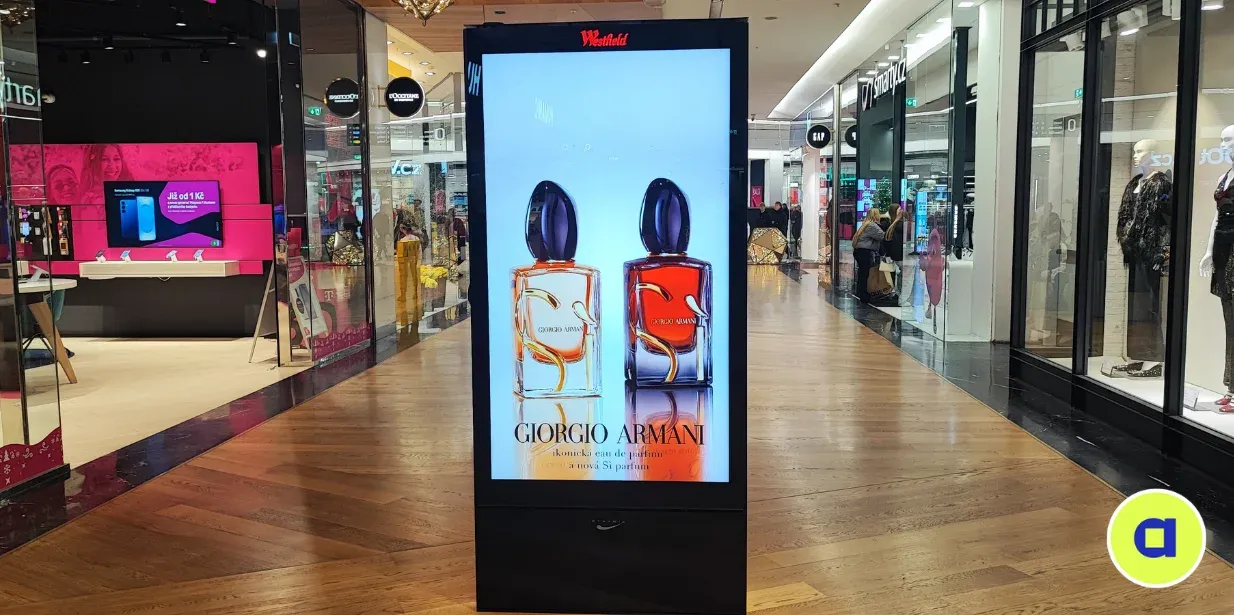
You are sitting in a café, enjoying your morning coffee, and suddenly your gaze stops on a screen on the wall opposite you. Dynamic videos, smooth animations, and bright visual accents involuntarily attract attention. At this moment, a logical question arises: what kind of screen software is used to create such compelling Digital Signage content?
Or another situation: you are the owner of a shop, restaurant, or service business and realize that static posters no longer work. You want to update communication with your customers, but you do not fully understand where to start and what role the player plays in this process. This guide was created precisely for such cases.
Below, we will take a detailed look at what Digital Signage is from a business perspective, why the choice of a player is critically important, and which aspects are worth paying attention to so that the solution is effective not only today but also in the long term.
Introduction to Digital Signage: why it matters for your business
Digital Signage, or digital signage displays, is a modern visual communication tool that allows informational and advertising content to be broadcast through screens in real time. Such solutions are actively used in retail, HoReCa, hotels, banks, business centers, and transport infrastructure.
The main reason for the popularity of this format lies in its ability to work effectively with attention. Moving images, video, and animation are perceived much faster and better than static media. That is why a digital signage system becomes not just an information channel, but a full-fledged element of a marketing strategy.
It is also worth noting the flexibility of this approach. Content can be updated centrally, without printing and logistics, and messages can be changed depending on the time of day, season, or specific location. This gives businesses access to the advantages of digital advertising that were previously available only to large online platforms.
The role of the player in the Digital Signage ecosystem
A player in Digital Signage is not just a device for video playback. It is a key link between content and the screen, responsible for display stability, correct rendering of materials, and interaction with the software platform.
It is the player that determines whether content will launch on schedule, whether different file formats will be supported, and how reliably the system will operate without constant staff intervention. In commercial projects, this is critical, as any malfunction directly affects brand perception.
In addition to the technical side, the player plays an important role in creating the atmosphere of a business. A properly selected solution makes it possible to integrate visual content with the space: emphasize the style of the venue, set the mood, support brand identity, and make the customer’s stay more comfortable and memorable.
Why choosing a player is a strategic decision
When selecting a player for Digital Signage, a business is effectively laying the foundation of the entire system. This choice determines the scalability of the screen network, the ability to integrate with other digital services, and the overall economic efficiency of the project.
An incorrectly selected player can limit development: it may not support complex scenarios, operate unstably, or require constant manual maintenance. In contrast, a high-quality solution makes it possible to build a flexible and manageable infrastructure that strengthens business results over time.
In the following sections, we will examine the key characteristics of Digital Signage players, typical usage scenarios, and practical recommendations that will help you choose the optimal option specifically for your project.
Key characteristics of Digital Signage players
When choosing a player for Digital Signage, it is important to view it not as a standalone device, but as part of an integrated ecosystem of screens and content. This is especially relevant for projects that use televisions for restaurants, cafés, or other public spaces, where stability and predictability of operation are crucial.
The first key parameter is performance. The player must handle high-resolution video playback, animation, transitions, and graphic elements without delays or “freezes.” This is critical for scenarios where an Indoor TV player is used, since content is often broadcast continuously for many hours and must look smooth at any moment in time.
Scalability is no less important. Even if one or two screens are used at the start, the network may grow over time. In such cases, a digital signage player should support operation as part of a larger system without the need for complete hardware replacement. This allows the business to grow gradually, without sharp investment jumps.
Special attention should be paid to the operating system. In practice, an Android media player is increasingly chosen, as this platform is well adapted to Digital Signage tasks, supports CMS-based content management, and receives regular updates. System stability and compatibility with software directly affect the uninterrupted operation of the entire screen network.
Technical interfaces also matter. The presence of HDMI, USB, Ethernet, and Wi-Fi simplifies integration with screens, networks, and external data sources. In many scenarios, it is convenient when an Android set-top box supports remote management: content updates, reboots, or diagnostics can be performed without physical access to the device.
The final, but no less important factor is reliability. The player must be designed for long-term continuous operation, especially in commercial environments. Before making a choice, it is advisable to study the experience of other users, the manufacturer’s reputation, and real-world business use cases of the device. This is what helps avoid hidden risks and ensure stable Digital Signage operation in the long term.
How to choose the ideal player for your project: practical recommendations
The first recommendation — choosing a Digital Signage player always starts with a clear understanding of business objectives. Different scenarios — from informational screens on the sales floor to complex advertising networks — require different approaches to hardware and software logic.
The second recommendation — the technical requirements of the project. Screen resolution, 4K support, and types of content (video, animation, static images, interactive blocks) directly influence the choice of player. For networks where real-time price and menu updates are important, performance and operational stability become critical factors.
The third recommendation — the installation location. Indoor solutions usually do not require protection from weather conditions, but must operate continuously and quietly. For commercial spaces where content is complemented by sound, a dedicated indoor audio player plays a separate role, allowing audio to be correctly integrated into the overall playback scenario.
The fourth recommendation — the management architecture. If a business operates a large number of screens, a centralized video management system significantly simplifies scaling and control. It allows campaigns to be launched on a schedule, changes to be made quickly, and a unified playback logic to be maintained across different locations.
The fifth recommendation — the project budget. It is important to assess not only the initial cost of the equipment, but also the total cost of ownership: maintenance, updates, support, and potential downtime. In the long term, investing in a more reliable solution often proves to be more economically efficient.
Integrating the player into your Digital Signage platform: steps to success
The process of integrating a player into an existing Digital Signage infrastructure requires a systematic approach. The first step is checking compatibility with the platform and software. The player must support the required file formats, codecs, and data exchange protocols.
Next, network parameters are configured. A stable connection is the foundation for real-time content management, especially when content changes frequently or depends on external data. At this stage, it is also important to plan access control and information security.
A separate block is playback logic. For networks that use digital signage for retail, it is important to ensure correct synchronization of advertising content between screens so that messages look consistent and professional within a single space.
In more complex scenarios, Digital Signage goes beyond visual communication. Audio-visual integration makes it possible to combine image, sound, and even other digital channels into a single experience for the visitor. This is where the player becomes a key element of the entire system.
The final stage is testing. Checking scenarios, load, operational stability, and advertising automation helps identify weak points before a full launch. This approach ensures not only technical reliability, but also a predictable business result from using Digital Signage.
In summary, a Digital Signage player should be viewed not as a separate technical element, but as the foundation of the entire communication system.
The stability of playback, flexibility of content management, and the ability of screens to truly work toward business goals depend on the correct choice and proper integration. A systematic approach is what makes it possible to transform Digital Signage from a set of screens into an effective tool for audience engagement.
Advision is a content management system for remote control, media planning of video and audio content broadcasting, and a supply-side platform for monetising advertising time. We also implement a Wi-Fi tracking system to measure quantitative indicators of the advertising audience.
We help Digital Signage owners and DOOH advertising operators earn money from advertising, automate work processes, and build a reliable media infrastructure using AdTech and MarTech software solutions.
Contact us if you want to increase your profits and implement the latest technologies to solve your problems!